© Pendennis Shipyard — direct newsletter Issue 74, May 2026 | Direct newsletter source email #164; full SHA256 and source URL in provenance manifest.
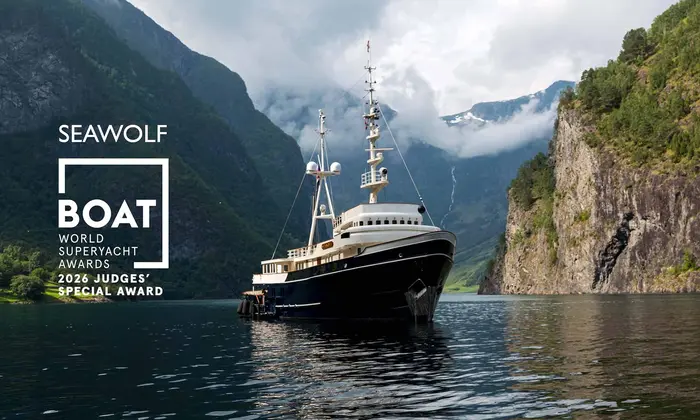
1957 former tug SEAWOLF wins a 2026 World Superyacht Awards rebuild honour after Pendennis hybrid-propulsion, structural and interior transformation.
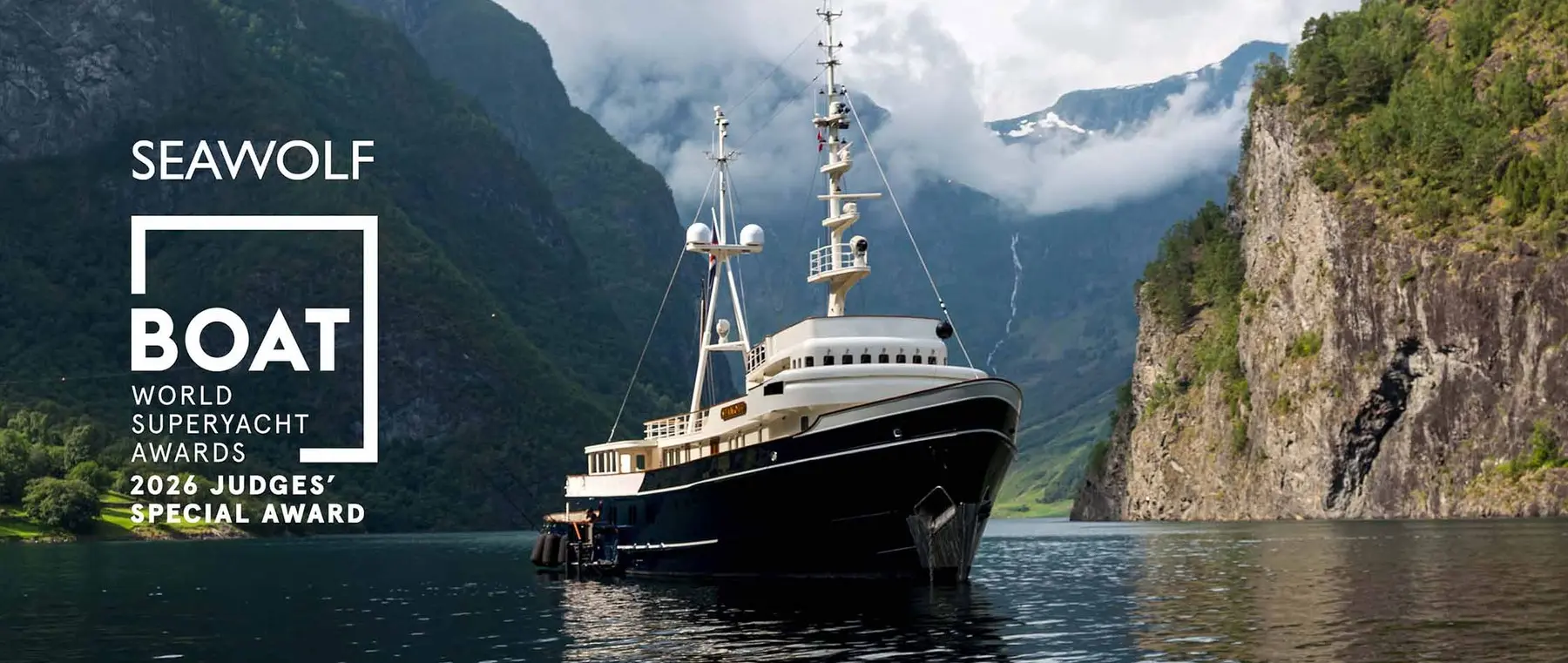
The 58.8-metre explorer yacht SEAWOLF received the Judges' Special Award for a Rebuilt Yacht at the 2026 World Superyacht Awards, an acknowledgement of a Pendennis programme that sought to reconcile the vessel's working-ship heritage with a substantially modernised technical and living environment. The announcement appeared in the yard's May 2026 original company newsletter alongside a separate award for SOLACE. These are not interchangeable projects: SEAWOLF was originally the ocean-going tug CLYDE, constructed in 1957, while SOLACE is a 2005 Feadship. The distinction matters when identifying builders, comparing photographs and updating the fleet. Pendennis performed SEAWOLF's later rebuild but did not build her original hull.
Pendennis identifies the vessel's first life as the tug CLYDE, launched in 1957 by J & K Smits Scheepswerven. Over subsequent decades, she was converted into a luxury motor yacht before the latest major programme brought her to Falmouth. That progression gives the modern SEAWOLF a different kind of pedigree from a purpose-designed contemporary explorer built from a fresh set of plans. The historic steel platform and many design decisions date back to an era when the vessel served a practical maritime purpose. Refits do not erase that origin. For a fleet database, the original yard, build year and former name should remain visible while Pendennis is credited for the most recent reconstruction.
The shipyard's official case study states that SEAWOLF arrived in 2022 for an extensive rebuild. The initial task was to understand what could be preserved and what required fundamental replacement. A vessel that has lived through several technical generations can have systems, structural arrangements and machinery access very different from those expected on a new-build explorer. That complexity is amplified when an owner wants to modernise performance and accommodation while retaining the visible character of the original hull. The programme in Falmouth was therefore described as more than an ordinary refit. It became a comprehensive reconstruction addressing engineering, structure, interior planning and the vessel's future use.
Historic yachts are sometimes celebrated for details that would seem impractical if designed from scratch. In SEAWOLF's case, the original working-ship identity informed the project's visual character and engineering decisions. Pendennis records changes to exterior features while preserving a recognisable explorer profile. The renewed vessel gained aluminium masts, a redesigned funnel and a hydraulic side-boarding platform, while the general appearance continued to acknowledge its earlier life. It is important not to invent an untouched original condition: the ship underwent major modifications in the decades before the Pendennis rebuild. The work is better understood as a careful reinterpretation of a complex historical vessel than as a simple return to an identical 1957 configuration.
The yard's official description details extensive structural attention, including steelwork repairs, new bulkheads and work to address corrosion. Such interventions are fundamental to the service life of older vessels because structural condition influences the practicality and economics of any higher-level design ambition. A new lounge or a sophisticated propulsion system cannot compensate for unaddressed foundational material problems. The source confirms major interventions but does not provide a total steel-replacement tonnage or a full classification-survey report. Consequently, a technical summary should focus on the verified categories of work rather than supplying unsupported quantitative claims. The award recognition is associated with the scale and execution of the reconstruction, not a published measurement of each replaced panel.
One of the programme's most notable aspects was the installation of hybrid propulsion. Pendennis reports that spaces formerly occupied by fuel tanks were repurposed as dedicated battery rooms, a clear example of how existing interior volume was reassigned to support different operating requirements. New equipment was integrated into a vessel never originally designed for contemporary energy storage and control systems. The yard describes the resulting arrangement as allowing silent, emission-free operating modes. That is a statement about certain conditions of operation, not proof that the entire yacht has zero emissions across every voyage. An accurate presentation should distinguish those operating modes from the broader environmental footprint of the machinery and the energy ultimately used to charge the batteries.
Pendennis's case study states that SEAWOLF's original diesel engines were preserved and modernised as part of the programme. This is a striking counterpoint to the installation of hybrid equipment: not every element of an old engineering platform must be removed to produce an updated vessel. Retaining machinery can have implications for heritage and layout, while integration with new electrical, generation and control arrangements demands careful planning. The company also records new generators and an upgraded HVAC installation. The sources do not specify exact engine output, battery capacity or tested endurance in electric mode. Those figures should remain blank in the database until reliable technical documentation is obtained, rather than inferred from the general claim that the yacht has a hybrid system.
Beyond the propulsion changes, Pendennis identifies a comprehensive systems overhaul covering the practical infrastructure necessary for modern onboard life. Heating, ventilation and air conditioning received substantial attention, and interior planning was altered to suit contemporary use. That combination illustrates how owners assess an aging yacht: operational reliability and accommodation are connected, not independent checkboxes. Systems may have to be routed around retained structural elements, and equipment selection has consequences for service access and noise. The public source does not include engineering drawings or reveal the specific layout of every technical compartment. The value of the documented programme lies in the broad pattern of integration between older shipbuilding and new engineering requirements.
The interior redesign was led by Design Unlimited in collaboration with Ngila Boyd, according to Pendennis's official project material. It introduced an updated arrangement for the owners' spaces, with a revised flow between the main cabin, study and associated rooms. This type of work is important on a long-range yacht because occupants may spend extended periods aboard in varied weather and at different destinations. A private office and a sleeping area need to coexist without compromising each other. The updated plan, as described by the yard, can give those activities clearer separation while still supporting circulation. The design team's work is a later interior intervention; it should not be conflated with the unknown authorship of every historic fitting or the original tug's industrial arrangements.
A private deck on an explorer may be used for both rest and work. Pendennis's account describes moving the owner's cabin forward and arranging related spaces to allow quieter, more flexible use of the suite. That is a considered design change rather than a claim of simple luxury expansion. Contemporary interiors are often judged by their ability to support daily patterns without requiring the occupants to adapt to a rigid layout. On an older platform, achieving that degree of flexibility can be harder because underlying machinery and structural boundaries may restrict what can move. The yard's published account explains the planning ambition but does not give an exhaustive deck-by-deck schedule, which would need confirmation before being entered as an exact technical configuration.
The 2026 World Superyacht Awards recognised SEAWOLF through a Judges' Special Award for the completed rebuild. Pendennis announced the distinction in its May 2026 newsletter and public statement. The same communication noted that SOLACE won the separate Refitted Yacht category, following its own modernisation of a 2005 Feadship. Recording these awards separately is essential: otherwise an aggregated email can cause one yacht's history, photograph or accolade to be incorrectly attached to the other. The SEAWOLF award concerns the transformation of the 1957 former tug and its hybrid and structural renewal. It is not a trophy for an unconnected yacht of the same or a similar name, such as the newer Rossinavi SEAWOLF X.
Industry awards provide useful context, but they are not substitutes for engineering specifications or a comprehensive vessel identity check. A refit may receive considerable recognition while some details of its equipment remain commercially private. The original newsletter establishes what Pendennis reported and which categories were recognised; the shipyard case study gives a more precise description of the work. Together, those sources justify updates to the yacht's recorded history and an article about the award. They do not justify declaring a newbuild, fabricating an owner, claiming an exact new top speed or creating a second yacht entry for the same hull. Every such assertion would require a separate and credible source.
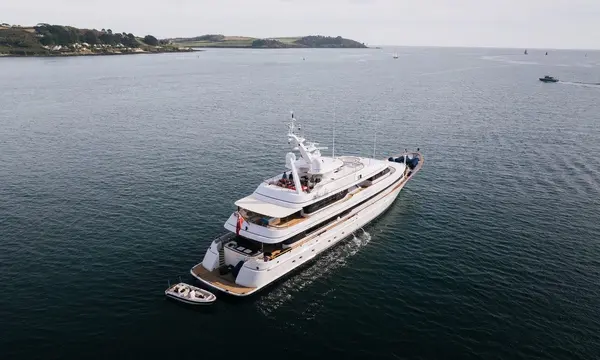
The May 2026 company email included a specific SEAWOLF photograph distributed through Pendennis's press image system. That file has been retrieved, its dimensions checked and its original content fingerprinted before being registered as Wagtail image 9298. The photograph is attached to this SEAWOLF account rather than a similar name in the fleet. This is a modest but important standard of news production. Image searches can return unrelated boats, historical renderings or old photographs with insufficient captions. A direct first-party press source, tied to the relevant email and project date, provides stronger evidence about what the image actually shows. It also allows the image's source and rights basis to be preserved alongside the article.
The published fleet record for SEAWOLF retains J & K Smits Scheepswerven as the original 1957 builder while recognising the later Pendennis work. The distinction is not only historically accurate; it helps owners and researchers understand how the hull evolved from CLYDE through conversion and reconstruction. Pendennis's achievements are considerable and deserve to be described precisely, but they are refit achievements. Reassigning original construction to the refit yard would obscure a vessel's long service life. The same principle applies to original length, current registered dimensions and dated construction changes. A superyacht database should capture successive layers of history rather than replacing one manufacturer's identity with another as each substantial project is announced.
SEAWOLF's award illustrates a route by which a historic maritime vessel can remain relevant to modern private cruising. The latest programme combined structural repair, hybrid operating capability, renewed services and redesigned living spaces within a hull dating back to 1957. It also confronted an important design challenge: protecting a recognisable heritage identity while making the platform workable for contemporary expectations. The 2026 honour belongs to that achievement. The source record does not tell us where SEAWOLF is cruising today, what she would cost to operate or whether further refit projects are planned. It does provide substantial, verifiable evidence of the yard's work and a clear explanation of why the judges recognised it.
Sources and provenance: Pendennis Shipyard original case study of SEAWOLF; official 2026 World Superyacht Awards report covering SEAWOLF and SOLACE; original Pendennis May 2026 newsletter Issue 74, correspondence ID 164, with official Wagtail image 9298.
© Pendennis Shipyard — original direct press newsletter photograph, original MIME SHA retained
Explore
Go deeper into the yachts, companies, events and destinations directly connected to this article.
Continue reading
Pendennis details a second major transformation of the 68.8m expedition yacht JESTER, with hybrid propulsion, new machinery and exhaust treatment following her 2023 rebuild.
The 58.83m Dutch-built expedition yacht SEAWOLF was observed in Amsterdam on 19 October, following an extensive two-year refit at Pendennis completed in 2024.
The 57-metre Feadship motor yacht Solace has won Best in Refit at the 2026 International Superyacht Society Design & Leadership Awards, recognising an extensive …
The original 1981 Feadship GIN-TONIC entered an extensive Pendennis refit in 2026. How a four-metre extension, engine change and historic identity are being documented.
Superyacht Guide
Continue into the wider Superyacht Guide.
Business opportunities · Superyacht Guide
Companies serving the superyacht market can discuss clearly identified advertising, sponsorship and business-profile opportunities. Commercial activity remains separate from independent editorial coverage.