
IYC Monaco Panel Links Crew Welfare to Better Yacht Charters
An IYC and SuperYacht Times panel at Monaco Yacht Show 2026 examined how crew rest, staffing, mental wellbeing and working culture affect the guest …
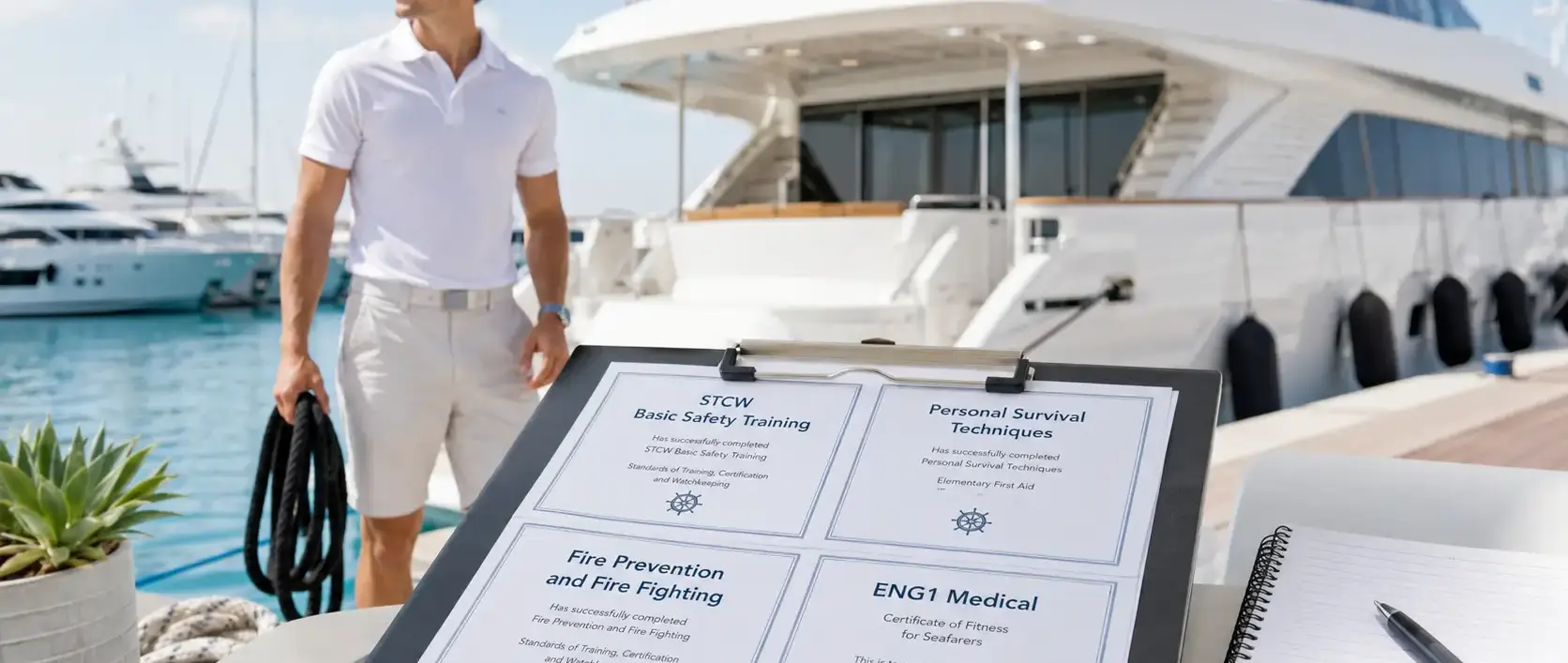
STCW is the safety-training foundation for most professional superyacht crew, but the rules are often misunderstood. This 2026 guide explains the basic courses, current training costs, five-year updating requirements and the new PSSR requirement affecting existing seafarers.
STCW is one of the first acronyms most people encounter when they start looking for work on a superyacht, but it is often described too loosely as a single certificate that simply “expires every five years”. In reality, STCW is the international framework for seafarer training and competence, and the entry-level package used by yacht crew combines several separate basic-safety modules with additional security and medical requirements depending on the job and flag.
For new superyacht crew, the practical question is usually straightforward: which courses must be completed before joining a yacht, what should a realistic 2026 training budget look like, and what has to be renewed later? The answer matters because the wrong course, an unapproved provider or an out-of-date safety module can delay employment even when the candidate has already spent significant time and money preparing for the industry.
The International Maritime Organization’s STCW Convention sets minimum international standards for the training, certification and watchkeeping of seafarers. For entry-level yacht crew, the familiar “STCW Basic Safety Training” package normally refers to four core elements: Personal Survival Techniques, Fire Prevention and Fire Fighting, Elementary First Aid, and Personal Safety and Social Responsibilities.
Those four modules cover very different risks. Survival training deals with abandon-ship procedures, lifejackets, immersion suits and liferafts; fire training combines prevention with practical firefighting and breathing-apparatus work; first aid covers immediate response to injury or illness; and PSSR deals with safe working practices, responsibilities, communication and life in a shipboard working environment. The point is not to create a yacht-specific finishing school, but to establish a common safety baseline before a seafarer is expected to work as part of a professional crew.
A current Bluewater Basic Safety Training package is delivered over five days in Antibes and Palma. Bluewater describes the course as covering the four core modules and currently includes an online MCA-approved Proficiency in Security Awareness course as part of its package, but Security Awareness should still be understood as a separate STCW security qualification rather than a fifth basic-safety module.
That distinction becomes important once a crew member is assigned security duties. Proficiency in Designated Security Duties may be needed where the role includes designated security responsibilities, while more senior security functions have their own training requirements. A seafarer medical certificate is also separate from STCW training: it is evidence of medical fitness rather than a safety-course module, although training providers commonly advise candidates to obtain the appropriate medical before committing to a course.
Training prices vary by school, country and what is included, so there is no single worldwide STCW price. As a useful Mediterranean benchmark on 7 September 2026, Bluewater lists its five-day STCW Basic Safety Training at €1,295 in both Antibes and Palma, with scheduled courses continuing through the autumn and into 2027.
The headline course fee is not the entire entry budget for every candidate. Travel, accommodation, the seafarer medical, additional role-specific training and any separate security qualification can all add to the total, so crew planning their first season should budget beyond the basic package rather than treating €1,295 as the complete cost of becoming employable.
The most common STCW renewal misunderstanding is that every part of Basic Safety Training expires after five years and must be repeated from the beginning. Under the MCA Chapter VI training framework, the recurring updating requirement focuses on practical competencies including Personal Survival Techniques and Fire Prevention and Fire Fighting, with equivalent updating also relevant to advanced fire and survival-craft qualifications where those certificates are held.
Bluewater’s current combined update course for Personal Survival Techniques and Fire Prevention and Fire Fighting runs for two days and is priced at €690 in Antibes and Palma. That is a useful 2026 cost benchmark for crew approaching the five-year point, but the correct refresher path should always be checked against the certificates actually held, the issuing administration and the requirements of the yacht on which the seafarer intends to work.
There is also a separate 2026 change that should not be confused with the five-year practical refresher cycle. MCA Marine Guidance Note 718, updated on 3 September 2026 and replacing MIN 729, implements the new STCW PSSR competence covering the prevention of and response to violence and harassment, including bullying, sexual harassment and sexual assault.
For UK-certified seafarers, the MCA now requires the additional competence for all seafarers who are required to hold PSSR, while anyone who completed an MCA-approved PSSR course on or after 1 January 2026 has already received the new learning outcome. Those with earlier qualifying certificates can use the MCA-arranged OneOcean “Prevention and Response to Violence & Harassment” module, which is free of charge and should take around one hour; affected seafarers must complete it no later than 31 March 2027 and retain the digital Verification of Training.
For somebody entering yachting, the safest approach is to separate universal safety requirements from employer preferences and career extras. Complete an approved Basic Safety Training package, make sure the appropriate medical and security training are in place for the intended role, keep the individual certificates and completion dates organised, and do not assume that a short course advertised simply as “STCW” will automatically satisfy the administration whose certificates you will later need.
For existing crew, renewal planning should start well before a certificate becomes a joining problem. Check the dates on survival and fire certificates, identify any advanced updating requirements, deal with the 2026 PSSR addition where it applies, and verify the exact evidence your flag state, employer or training authority expects; doing that early is usually cheaper and easier than discovering a gap during recruitment, revalidation or a pre-joining document check.
Continue reading
An IYC and SuperYacht Times panel at Monaco Yacht Show 2026 examined how crew rest, staffing, mental wellbeing and working culture affect the guest …
Captain-developed software from Helmwise turns crew notes and handover material into structured records, addressing the loss of operational knowledge when superyacht personnel rotate.
TWW Yachts has launched its 2026 Crew Awards programme, creating four categories covering teamwork, guest experience, individual contribution and onboard content.

D-Marin is positioning winter home ports around crew welfare as well as yacht operations, combining community, wellness, shoreside access and digital administration.
Superyacht Guide
Continue into the wider Superyacht Guide.
Business opportunities · Superyacht Guide
Companies serving the superyacht market can discuss clearly identified advertising, sponsorship and business-profile opportunities. Commercial activity remains separate from independent editorial coverage.