
Besenzoni MEMORA Wins 2026 Yacht Balcony Design Award
MEMORA by Giada Faccini and Elisabetta Savoldi wins the fourth Giovanni Besenzoni Award for Yacht Design, recognising creative concepts for a yacht balcony inspired …
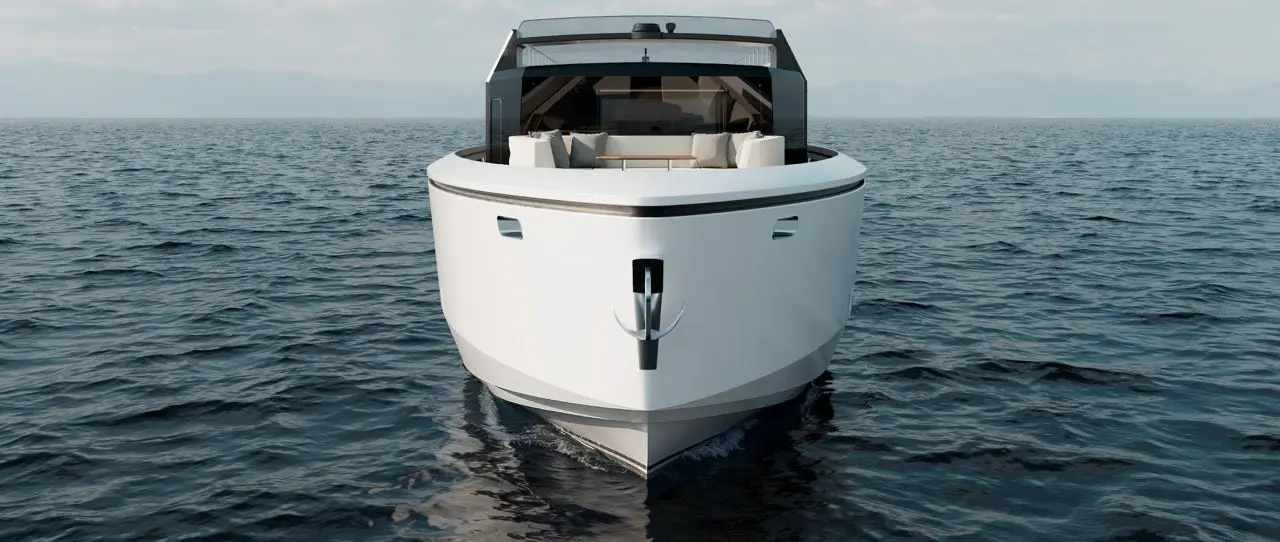
© Amer Yachts / AOUMM. First-party 27.5m AMER 9 exterior design rendering, not a photograph of a launched yacht.
The official 27.5-metre AMER 9 specifications confirm a GRP-and-aluminium concept designed inside and out by Milan-based AOUMM. Here is how its design approach connects to the 29.9m AMER 10 and 38m AMER 12 and what remains unconfirmed about build status.
Amer Yachts' 27.5-metre AMER 9 concept is now one of the clearest public illustrations of how the Italian shipyard is developing a different design language for its next generation of composite superyachts. The manufacturer's official AMER 9 project page lists glass-reinforced plastic and aluminium as the proposed construction materials, with Milan-based AOUMM credited for both exterior and interior design. It identifies a 27.50-metre length overall and provides original exterior and interior renderings as well as layout drawings. This is a design-stage project, not an announcement that a yacht has launched, changed hands or completed trials. That distinction is especially important as fresh late-November industry attention returns to the three-model AOUMM collaboration first described by Amer Yachts on 6 July 2026. For prospective owners, the news is less about an unverified delivery date and more about the relationship between hull size, material choice and the quality of space aboard a yacht just above the 24-metre superyacht threshold.
The basic dimensional fact is straightforward: AMER 9 is listed at 27.50 metres length overall. The maker describes its material system as GRP, or glass-reinforced plastic, combined with aluminium, and it names AOUMM as the exterior and interior designer. These details are confirmed directly by the model page, unlike projected maximum speed, engine options, displacement or fuel consumption, which are not presented there as a complete verified technical specification. A buyer or surveyor should avoid treating a conceptual material description as a finished scantling plan. The eventual structural arrangement, class requirements, machinery choices and detailed engineering are questions for a builder's approved documentation, rather than numbers extrapolated from a rendering.
In its July project announcement, Amer Yachts positioned AMER 9 alongside AMER 10 and AMER 12 as a conscious departure from its previous composite design paths. The yard said the partnership with AOUMM would explore different proportions, spatial arrangements and ways of living aboard while preserving continuity with comfort, reliability, efficiency and a close relationship with the sea. That wording describes design intentions, not measured operational outcomes. It nevertheless matters in a sector where new model names sometimes conceal modest revisions of an established deck plan. The published exteriors and layout documents establish that the design programme is broad enough to consider how accommodation, silhouette and circulation fit together before individual systems are finalised.
The manufacturer-provided AMER 9 gallery includes several exterior views, interior impressions and separate side, fly-deck, main-deck and lower-deck layout illustrations. Those are valuable references for discussing the proposed design, but they remain artist impressions and design drawings. They should not be represented as photographs taken on a completed yacht. The selected lead image for this report is an original AMER 9 exterior rendering sourced directly from the shipyard, with the model correctly identified in its caption and image credit. Renderings show visual priorities more clearly than they show real-world ergonomics: handrail geometry, maintenance clearances, storage volumes, boarding routes and physical finishes still require detailed design review before a purchaser can consider them resolved.
At 27.5 metres, AMER 9 sits above the 24-metre editorial threshold for the superyacht sector while remaining substantially more compact than the 38-metre AMER 12. That middle ground can be attractive to owners wanting a personally managed cruising experience with meaningful accommodation, without necessarily approaching the operating profile of a much larger vessel. Length alone, however, does not determine crewing, regulatory status, port costs or maintenance complexity. Flag, use, tonnage, design category and machinery all matter. The relevance of the 27.5-metre proposal lies in how effectively the builder can translate its chosen footprint into practical accommodation and access rather than in the assumption that a certain hull length guarantees a particular lifestyle.
Amer Yachts lists the related AMER 10 concept at 29.90 metres, again using a GRP-and-aluminium material description and AOUMM for the exterior and interior. That places it only 2.4 metres longer than AMER 9, making comparison between their arrangements particularly informative. The small difference in overall length should not be interpreted as a proportional gain in every cabin or outdoor area, since beam, deck structure and compartment choices have not been established in a side-by-side final specification. The point is that the shipyard is showing more than one solution within a closely related size class. Owners can evaluate which configuration better suits guests, privacy, watersports and practical access rather than choosing solely by nominal length.
The larger AMER 12 project is listed at 38 metres and carries the same AOUMM design credits and combined GRP-and-aluminium material approach. Its greater size allows the builder to explore a different set of proportions and deck relationships, as illustrated by its official side, sun-deck, upper-deck, main-deck and lower-deck drawings. It would be premature to claim exact cabin counts, service volumes or weights not confirmed in the published project information. Viewed together, the AMER 9, 10 and 12 reveal the breadth of the collaboration: a shared design partnership applied to three separate size envelopes rather than a single render circulated under different names.
Composite construction offers naval architects flexibility in shape and structural design, but its environmental and operational merits cannot be established from the word GRP alone. Weight depends on laminate specification, core materials, resin system, structural safety factors and installed equipment. Aluminium components introduce additional considerations about fabrication, insulation, joining methods and corrosion management. Amer Yachts presents the programme within a wider approach to efficiency and lower-impact design, yet the public model pages do not provide a verified lifecycle assessment or measured fuel-burn comparison for AMER 9. Any future claim of a quantifiable reduction should be backed by documented baselines and independently assessable data, not simply by a description of intended construction materials.
The yard's 6 July announcement distinguished its three AOUMM composite projects from AMER 42A, a separate aluminium design developed with Antonio Luxardo and Optima Design. In that project, the letter A denotes aluminium, which the company says would be used for both hull and superstructures. The manufacturer linked that material direction to reduced overall weight, increased efficiency and a more dynamic onboard experience. Those are stated design aims, not test results. The important development for the group is a two-track strategy: AOUMM leading a new composite design family while an established collaborator works on a separate all-aluminium project. Treating all four as the same construction programme would obscure the actual division of design responsibility and material approach.
A published project page can confirm a builder's design intention while leaving major purchasing questions open. An owner examining AMER 9 should request the stage of engineering development, the proposed construction contract, expected class and flag requirements, an approved general arrangement and a clear list of standard versus optional equipment. It is also worth checking whether the quoted length includes appendages or bathing-platform arrangements and how any promised performance has been measured. None of those matters should be invented by editorial commentary. In particular, the presence of polished official visuals is not evidence that a hull has been laid, a contract signed or a launch date secured. The project should be assessed on its documented maturity.
AOUMM is credited for both outside and inside design, suggesting that the studio is working across the visual and accommodation experience rather than receiving a purely decorative brief. This can help designers avoid conflicts between the yacht's overall proportions and its internal spaces, although the extent of the studio's engineering responsibility is not specified by the publicly available project page. Questions about glazing, circulation and living spaces are therefore best considered together with structure and servicing. A light-filled saloon, for example, still requires attention to shading, weather protection, emergency escape and maintainability. These are design criteria buyers can ask the yard to address; they are not defects that the published AMER 9 materials prove exist.
The inclusion of separate deck drawings makes the model page more useful than a single atmospheric exterior perspective. A potential owner can begin a disciplined discussion about guest separation, outdoor social zones, service routes, access to machinery and how the yacht would operate at anchor. Those drawings are still concepts, so the proportions and permitted uses need confirmation against a final general arrangement. A visually generous fly deck may not tell the whole story about stability, windage, stowage or tender handling. Equally, photographs or renders of an elegant lower deck rarely reveal the access requirements for filters, pumps and other equipment. Asking these questions early is a constructive way to test whether the maker's design intent can translate into a reliable working vessel.
Amer Yachts has repeatedly presented more efficient propulsion, appropriate weight control and a lower-impact strategy as themes in its corporate work. Its July announcement applied that direction to the new projects, while leaving performance measurements for individual concepts to be demonstrated. For the industry's environmental conversation, there is an important difference between a yacht designed to be more efficient and a yacht whose efficiency advantage has been established with comparable data. Useful future evidence would include displacement targets, operational profiles, engine or hybrid configuration, lifecycle material assumptions and a consistent comparison against another yacht with similar mission requirements. Until such evidence is published, the responsible conclusion is about the design direction, not a certified emissions reduction.
The underlying four-project introduction dates to July 2026, and the official AMER 9 specification and images remain available on the shipyard's website in November. A new analysis of the concepts should not change that original date or describe the renderings as a fresh boat launch. Nor do the referenced pages establish an agreed delivery calendar, final pricing or contract status for this individual yacht. The news value is the opportunity to place a clearly documented project alongside its sister designs as the market examines future builds. There is particular relevance for owners comparing options around 27–30 metres, where a difference of only a few metres can alter the practical trade-offs among accommodation, crew areas and usable deck space.
A credible comparison needs a common specification and a defined operating profile, not just photographs and headline lengths. The official length and builder's material statement provide a starting point, but the next stage should include verified beam, draft, full-load displacement, machinery, range at stated speed, class documentation and final cabin arrangement. Sea trials, build quality and service access cannot be assessed from concept artwork alone. The shipyard's official news and events page will be the first place to check for further development announcements, while individual project pages can confirm revisions. For now, AMER 9 is a distinct 27.5-metre AOUMM-designed concept within a three-model programme, with original manufacturer visuals and specifications but no confirmed published launch event.
Original primary record: Amer Yachts official AMER 9 concept specifications and renders. © Amer Yachts / AOUMM. First-party 27.5m AMER 9 exterior design rendering, not a photograph of a launched yacht. Original first-party media: source photograph or official illustration. Copyright and image source are credited; first-party availability does not imply unrestricted reproduction permission.
Continue reading
MEMORA by Giada Faccini and Elisabetta Savoldi wins the fourth Giovanni Besenzoni Award for Yacht Design, recognising creative concepts for a yacht balcony inspired …
Ferretti Yachts unveils INFYNITO 100, its new 100-foot flagship with private upper-deck owner accommodation and versatile aft and forward terraces.
Australian designers unveil SATURDAY, a 43-metre aluminium superyacht concept with a proposed 2.5-metre draught, 9.1-metre beam and flexible indoor-outdoor spaces.

FOILER sets out its 28m GHOST hydrofoil superyacht with a planned 2029 launch, carbon and titanium construction, panoramic glazing and solar-powered systems.
Superyacht Guide
Continue into the wider Superyacht Guide.
Business opportunities · Superyacht Guide
Companies serving the superyacht market can discuss clearly identified advertising, sponsorship and business-profile opportunities. Commercial activity remains separate from independent editorial coverage.