
Williams ES10M Secures First 80m-Plus Yacht Customer for Threefold Energy Upgrade
Williams Grand Prix Technologies has disclosed that the first customer for its ES10M marine battery system is an 80-metre-plus yacht targeting triple the installed …
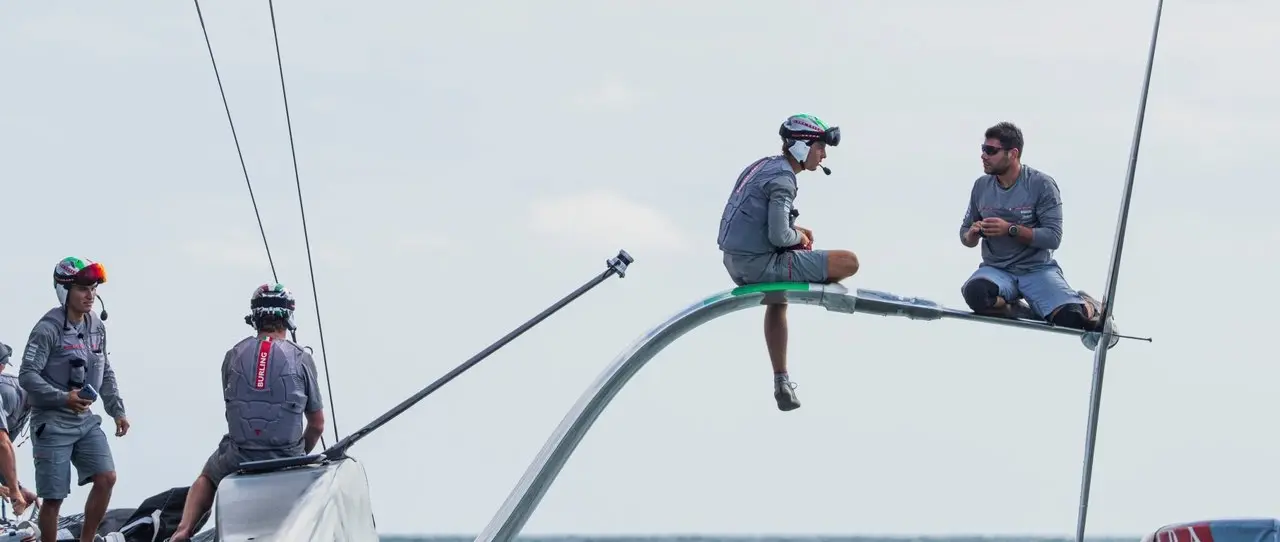
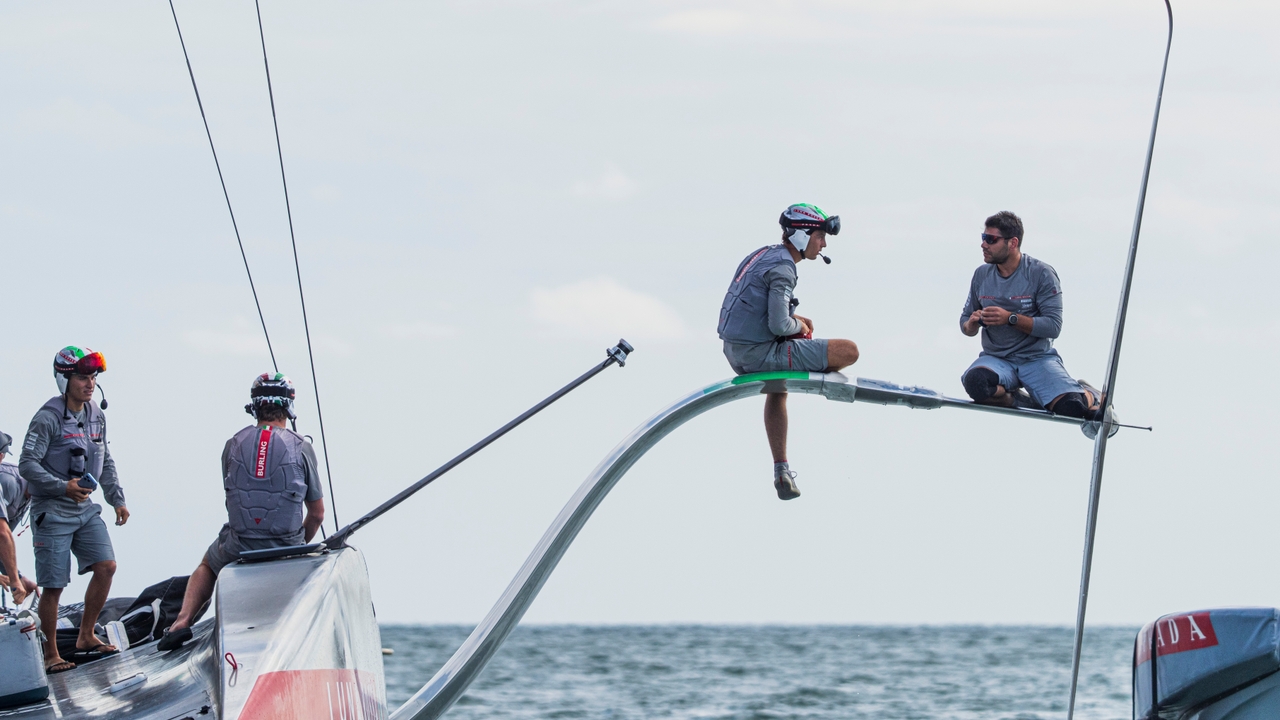
© Ivo Rovira / America's Cup. Official archival 23 October 2026 AC75 reconnaissance photograph.
A November 2026 official America's Cup technical report explains how sensors monitor speed, ride height, structural strain and control inputs aboard the foiling AC75.
The America's Cup has published a technical explanation of the sensor systems that underpin high-performance AC75 foiling yachts, drawing attention to an aspect of racing rarely visible in spectacular photographs. The organiser's original analysis, dated November 2026, describes a network of devices measuring speed, orientation, loads, pressures and movement as the boats travel at more than fifty knots. The piece is relevant to yacht technology because it demonstrates how advanced sailing increasingly depends on capturing reliable information rather than interpreting appearances alone. Its claims concern measurement and the engineering process, not the announcement of a new yacht launch or proof that one team has achieved a winning advantage. The distinction matters: sensors help teams understand a complex machine, but data collection does not eliminate the uncertainties of wind, waves or sporting competition.
An AC75 can rise above the water on a lifting foil, reducing much of the hull's normal contact with the sea. That operating mode can support extraordinary performance but places significant demands on the coordination of boat speed, foil angle and sail power. A relatively small change can alter the forces acting on a yacht moving rapidly across an uneven surface. Measurements provide designers and sailors with a more detailed understanding of what is happening than a simple visual observation from a chase boat. Yet the fact that a boat is equipped with sophisticated instruments does not mean it can control every disturbance automatically. Human decisions, class rules and reliable systems remain essential. The organiser's explanation focuses on the technology beneath the visible spectacle.
High-precision satellite positioning systems provide important information about the yacht's speed, heading and movement across a racecourse. Such measurements can be studied alongside conditions and helm inputs to reconstruct a manoeuvre and understand why the boat accelerated or slowed. GPS data, however, should not be confused with a complete picture of the forces acting on sails and foils. A track records where a boat travelled; it does not by itself reveal the loads on a structural component. Teams therefore combine satellite data with other sensors and analysis. The organiser's account makes clear that several technologies are integrated to build a fuller view of performance. For readers used to ordinary navigation instruments, the difference lies in the precision and detailed engineering questions being asked.
Inertial measurement units, often called IMUs, use accelerometers and gyroscopes to measure changes in orientation and acceleration. The relevant variables include pitch, roll and yaw, terms describing the yacht's movement around different axes. When an AC75 is foiling at speed, these measurements can help explain how the boat responds to a gust, a wave or a change in control setting. The information may also reveal recurring behaviours that are difficult for crew members to distinguish while managing a demanding manoeuvre. It would be inaccurate to describe an IMU as a system that independently determines the best course to sail. It is a measuring instrument whose value depends on calibration, interpretation and the way its output is combined with other data.
The organiser also identifies ride-height monitoring as part of the AC75 instrumentation system. For a yacht that uses hydrofoils to lift most of its hull clear of the surface, the vertical distance from the water has practical consequences for stability and resistance. The aim is not simply to rise as high as possible. A useful operating condition must balance speed, control and the risk of losing stable flight when sea conditions or loads change. Reliable measurement helps teams understand how the hull and foil system behave through a run. Yet the presence of a sensor does not by itself establish a fully autonomous flight-control regime. The sailor's decisions and the technical rules applying to the boat shape how that information can be used.
Sensors embedded in or attached to structural components can help engineers observe the forces passing through a high-performance yacht. A foil arm, rigging component or sail-control element can experience substantial and changing loads. Measuring these values is useful when designers evaluate whether theoretical calculations correspond with real sailing conditions. The original technical article discusses strain measurement and load monitoring as part of the data ecosystem. Such instruments should not be confused with proof that every part is immune to damage. They can help identify stresses, but their usefulness depends on placement, reliability and the quality of subsequent analysis. In the America's Cup, where performance margins are small, better evidence about structural behaviour can inform design without eliminating the need for inspection.
An AC75 uses hydraulic mechanisms in multiple aspects of sail and foil control. Pressure, movement and command data can help engineers understand whether a device is responding as intended. The organiser's explanation connects these measurements with the larger system used by the sailors to make the boat perform. This matters because a control movement at the helm or inside a cockpit is not the same as the resulting motion of an underwater surface. Engineers need to understand delays, loads and the relationships between command and response. That work remains subject to the competition's technical regulations. A sensor network enables observation, while the permitted use of automation and control devices is defined by rules rather than by whatever software can theoretically be installed.
Gathering many measurements is only useful when the information can be collected, recorded and interpreted. High-speed sailing places instruments in a challenging environment of vibration, spray, impact and rapidly changing temperatures. The technical problems include keeping connections reliable and making sure data from separate sources can be compared in the correct time sequence. An isolated erroneous reading could mislead a performance analysis, so calibration and verification are crucial. The official article emphasises the sophisticated network of information beneath the carbon-fibre structure. That network is part of the engineering system, not an accessory whose only purpose is to produce a colourful graphic for spectators. Reliable data handling can be as demanding as installing the sensors themselves.
After a session, designers and sailors can study the relationship between the boat's settings, trajectory and measured loads. A manoeuvre that felt slow or difficult can be examined more precisely, allowing the team to test whether its interpretation of the problem was correct. The process resembles scientific experimentation: identify a question, make a controlled change where practical, collect evidence and compare results. Yet real sailing conditions are never perfectly repeatable, which limits how confidently one run can be compared with another. The organisers describe the technology as fundamental to understanding performance, but no public sensor dataset proving the superiority of a particular team is provided in this release. The article is an explanation of methodology, not a league table of engineering results.
An engineer may be interested in whether a foil experiences the loads predicted by a model, while a sailor may care most about whether the boat responds predictably during a tack. The same raw measurements can therefore answer different questions, depending on how they are presented. A successful system has to connect technical detail with decisions that can actually be made on or off the water. This involves communication between people who work with different tools and priorities. The official America's Cup description illustrates the close relationship between athlete and engineering teams without claiming that software replaces sporting judgement. In a competition where the limits of speed and reliability are constantly tested, the ability to translate data into useful action is an important organisational skill.
The AC75 is a regulated racing class, and its equipment must comply with technical rules. That framework matters because advanced sensors could otherwise be mistaken for unrestricted autonomous control technology. A competition may allow extensive measurement while limiting how some information is processed or applied during racing. The existence of a sophisticated telemetry system therefore cannot justify a claim that the yacht steers itself or that any algorithm can make every racing decision. The precise permitted arrangements are governed by the applicable class-rule version and interpretations. A reader interested in compliance should consult those documents rather than general technology marketing. The organiser's explanatory piece is a helpful introduction, but it does not replace the binding specification.
The tools used in elite foiling may have lessons for wider yacht construction, particularly in the practice of evaluating load paths, validating simulations and diagnosing unexpected behaviour. However, a full-size cruising superyacht operates under very different conditions from an AC75: its priorities may include comfort, efficiency and dependable long-term service rather than the fastest possible race. Transferring an approach requires adaptation and independent validation. It is not reasonable to claim that every innovation from an America's Cup boat will become standard equipment on the next generation of cruising yachts. The more general principle is that better measurements can support better engineering decisions when they address clearly defined problems. That principle extends across the marine sector even when the hardware is quite different.
The lead photograph is an original America's Cup reconnaissance image of a real AC75, credited to Ivo Rovira and the event organiser. Its purpose is to illustrate the kind of vessel whose measurement systems are being explained. It is not a picture of every individual sensor hidden inside the structure, nor does it demonstrate a new component being unveiled on the day of publication. The original source identifies the photographic setting separately from the technical briefing. That distinction matters because detailed engineering stories can easily be over-illustrated with images that appear to show equipment not actually present. Here the visual material provides an authentic reference for the class while the technical facts come from the organiser's own written analysis.
The availability of detailed performance information can improve decisions, but no system can remove weather uncertainty, human error or competition between similarly advanced teams. Every boat's measurements become meaningful only through careful interpretation and validation. The official source provides a strong explanation of how contemporary AC75 racing combines GPS, inertial data, ride-height information and load monitoring in an integrated approach. It does not say which yacht will win the 2027 America's Cup in Naples. Technology is a tool that helps competitors develop and operate their boats, not a substitute for sailing skill or an assurance of a result. Keeping that boundary clear prevents a technical feature from slipping into speculative race forecasting.
The organiser's November 2026 examination of AC75 instrumentation makes an important point about modern yacht technology: the decisive work is often invisible. Spectators see a boat racing above the sea, while crews and engineers rely on extensive measurement to understand the forces beneath that performance. The combination of positioning, orientation, load and control data allows a team to ask better questions about design and operation. It does not erase the limits set by class rules or the unpredictability of a close race. For readers interested in naval architecture, the article provides a documented account of the measurement culture behind elite foiling, distinguishing actual established engineering methods from exaggerated claims of fully autonomous sailing.
Original primary record: America's Cup original official 24 November 2026 AC75 telemetry and instrumentation analysis. © Ivo Rovira / America's Cup. Official archival 23 October 2026 AC75 reconnaissance photograph. Original first-party media: source photograph or official illustration. Copyright and image source are credited; first-party availability does not imply unrestricted reproduction permission.
© Ivo Rovira / America's Cup. Official archival 23 October 2026 AC75 reconnaissance photograph.
Continue reading
Williams Grand Prix Technologies has disclosed that the first customer for its ES10M marine battery system is an 80-metre-plus yacht targeting triple the installed …
Beneteau chief Bruno Thivoyon says electric propulsion technology could eventually add only 1–3% to boat prices as the group works with Fountaine Pajot on …
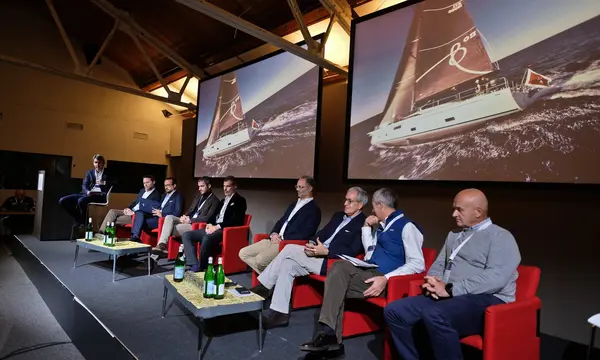
Owners and builders at Genoa's 27 November Sailing Super Yacht Forum shared lessons on hybrid propulsion, noise, onboard controls and environmental life-cycle assessment.

At Genoa's Sailing Super Yacht Forum, RINA representative Giorgio Gallo outlined a semi-autonomous navigation project and the unresolved question of who is responsible when …
Superyacht Guide
Continue into the wider Superyacht Guide.
Business opportunities · Superyacht Guide
Companies serving the superyacht market can discuss clearly identified advertising, sponsorship and business-profile opportunities. Commercial activity remains separate from independent editorial coverage.