Becoming a superyacht deckhand starts with the right safety training and medical certificate, but the first job is won by proving practical value on deck. This 2026 guide covers STCW, ENG1, deck duties, CV strategy, daywork and what to expect from a first season.
A superyacht deckhand is an entry-level member of the deck department, but the job is more specific than simply finding any first position on a yacht. Deckhands work on the exterior operation of the vessel, supporting maintenance, mooring, tender work, watersports and the routines that keep decks, equipment and guest areas ready for use.
Candidates looking for a broader introduction to joining the industry should start with Superyacht Guide’s guide to qualifications, costs and getting a first superyacht job. This article takes the narrower route: what a new deckhand needs before applying, what practical skills matter on deck and how to approach the first season without treating certificates alone as a guarantee of employment.
What does a superyacht deckhand actually do?
Deckhand work is practical and highly visible. Bluewater’s current guidance for people starting work on yachts highlights useful deckhand backgrounds including recreational sailing, painting, polishing, varnishing and watersports, while the wider role involves learning how the yacht expects routine exterior maintenance and deck operations to be carried out.
Mooring and line handling are particularly important because they place junior crew directly into safety-critical team operations. A new deckhand has to learn the yacht’s procedures, terminology and equipment rather than assuming that small-boat experience automatically transfers to a large yacht, and the same principle applies when helping with tenders, fenders, deck gear or guest watersports equipment.
For somebody entering from another industry, transferable skills can therefore matter more than a long list of unrelated courses. Practical experience with boats, painting, detailing, carpentry, mechanical work, watersports or physically demanding outdoor jobs can all help demonstrate that the candidate understands tools, finishes, equipment, teamwork and the standard of care expected around valuable assets.
STCW and ENG1: what a new deckhand needs before applying
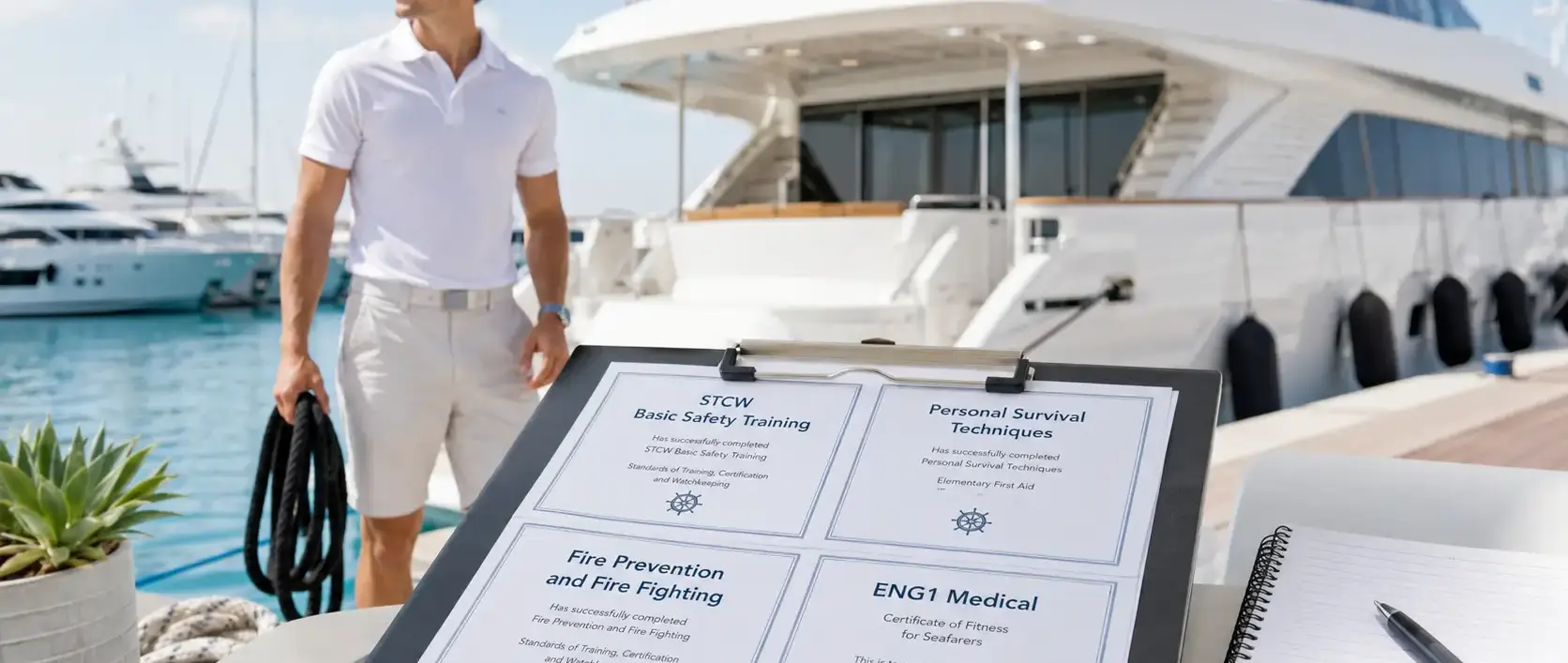
The regulatory starting point is safety training rather than a deckhand-specific licence. The UK Maritime and Coastguard Agency’s approved-training guidance identifies the core STCW basic-safety elements as Personal Survival Techniques, Fire Prevention and Fire Fighting, Elementary First Aid, and Personal Safety and Social Responsibilities, with Security Awareness also listed among MCA-approved STCW training categories.
A candidate also needs an appropriate seafarer medical certificate for the yacht and flag-state requirements that apply to the job. The MCA’s ENG1 guidance covers medical certification for seafarers, including yacht service, while its application guidance explains that an ENG1 examination must be carried out by an MCA-approved doctor and that a certificate is issued when the candidate passes the medical assessment.
There is also a 2026 change that new entrants should not overlook. MCA MGN 718 implements the amended PSSR competence concerning prevention of and response to violence and harassment from 1 January 2026, so somebody taking PSSR now should make sure the course is approved to the current standard rather than relying on older descriptions of the syllabus.
The MCA Yacht Rating certificate is better understood as an early progression credential than as the basic ticket required before a first day of deck work. MCA requirements for the yacht-rating route include being at least 17, completing basic safety training, holding an ENG1 or recognised equivalent and completing the required yacht service, including six months of onboard Yacht Service, so a green deckhand normally builds toward it rather than arriving with the sea-service requirement already completed.
Build a deckhand CV, not a generic yacht CV
The CV should make the candidate’s deck value obvious within seconds. Superyacht Guide’s separate guide to writing a superyacht CV covers the full structure in detail, while Bluewater’s green-crew CV guidance recommends concise presentation, simple readable formatting and a PDF document rather than an elaborate design that makes the important information harder to find.
For a first-time deckhand, the most useful evidence is often found outside previous yacht employment. The CV should identify current certificates and availability accurately, then translate sailing, watersports, painting, polishing, maintenance, mechanical, construction or other practical experience into specific skills instead of trying to disguise the fact that the candidate is new to superyachts.
Getting the first break and surviving the first season
The first permanent position is usually the hardest one to secure, which is why short-term work matters. Bluewater’s current entry guidance specifically discusses dockwalking, handing out a CV and daywork as routes into a first yacht job; where local marina and security rules permit it, daywork can give a candidate something a certificate cannot provide on its own — evidence that they can arrive on time, follow instructions, work carefully and fit into a deck team.
A first season should therefore be approached as the period in which a green deckhand converts training into credible yacht experience. The priority is to learn the vessel’s standards, become dependable during repetitive maintenance and deck operations, improve line-handling and tender competence, and build references and sea service rather than collecting additional courses simply because they are marketed to new crew.
That is also what separates the deckhand route from the broader question of how to enter yachting. STCW and ENG1 make a candidate ready to meet core safety and medical requirements, a focused CV makes their practical value easier to assess, and daywork or a first junior position creates the experience from which Yacht Rating, specialist deck skills and later deck-department progression can begin.