

Company
International Maritime Organization
Explore the company profile and related Superyacht Guide coverage.
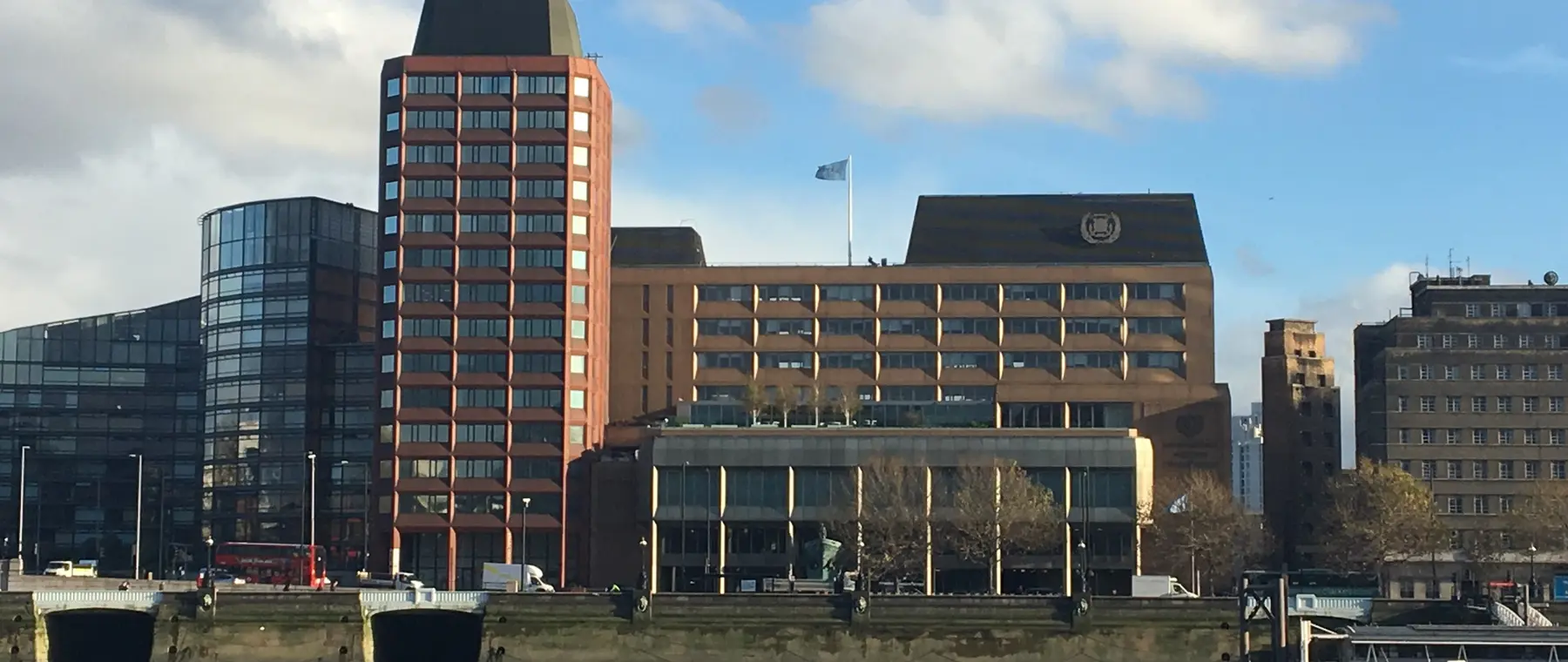
International Maritime Organization London headquarters — LordHarris archival photograph
IMO has outlined its 30 November–3 December MEPC 85 agenda, including emissions, ballast water, marine pollution, efficiency and underwater noise discussions.
The International Maritime Organization has published its preview of the eighty-fifth session of the Marine Environment Protection Committee, scheduled to take place in London from 30 November to 3 December 2026. An intersessional greenhouse-gas working group is due to meet during the preceding week. The programme includes discussions on greenhouse-gas reduction, ballast water management, pollution prevention, efficiency, underwater radiated noise and environmentally sensitive sea areas. The possible resumption of an extraordinary session on 4 December remains subject to confirmation. These are announced agenda items rather than final decisions. For the international superyacht sector, the meeting is important chiefly because the resulting regulatory direction may shape operations, refits and design decisions.
An IMO meeting preview describes matters that officials and member states expect to consider. It should not be interpreted as an announcement that every proposal has been adopted or that new requirements take effect immediately. Even when a treaty amendment is adopted, its entry into force and application can depend on subsequent procedural steps, the instrument concerned and the details of the final text. Flag administrations and other competent authorities may publish guidance relevant to particular types of vessels. Yacht managers should therefore distinguish between a measure under discussion, an adopted measure, and a requirement that applies to the yacht for which they are responsible. This distinction is particularly important when budget and maintenance decisions may be based on a briefing that emphasises the potential consequences of future regulation.
The word superyacht is commonly used within the industry to describe large pleasure yachts, but regulatory instruments use their own definitions, thresholds and categories. Gross tonnage, vessel length, propulsion arrangements, international operation and whether the yacht is used commercially can all be relevant. A rule intended for international commercial shipping may have limited or different applicability to an individual private yacht. Conversely, a yacht may already be subject to requirements that an owner incorrectly assumes apply only to merchant vessels. The appropriate starting point is the actual regulatory framework governing the vessel, including its registration, approved arrangements and operating profile. A general news report on MEPC should not be used as a definitive compliance checklist. Qualified advisers and the relevant authorities should establish any obligations that affect a particular yacht.
A central issue on the committee's programme is the continued development of mid-term greenhouse-gas measures for international shipping. Negotiations concerning the technical and economic elements of those measures remain ongoing. For yacht builders and owners, policy evolution can influence investment decisions even before the precise regulatory obligations are known. Engines, fuel systems and electrical installations are normally installed with a view to many years of operation, whereas the availability and cost of alternative fuels may change over a much shorter period. Owners commissioning new vessels may therefore ask builders to assess future adaptability, maintenance support and the operational consequences of different propulsion choices. Existing yachts will need to weigh potential changes against available space, engineering constraints and the cost of modifying an already integrated installation. The future direction of regulation is important, but it is not a basis for treating unsettled proposals as law.
The lifecycle assessment of marine fuels remains part of the broader emissions debate. A fuel's environmental performance cannot always be assessed solely by considering what occurs in the exhaust at the point of operation. The processes used to produce, transport and supply it can influence its overall greenhouse-gas impact. This creates practical questions for an international fleet that may bunker in many different ports. A yacht may have technical compatibility with a particular product without having dependable access to that product throughout its intended cruising programme. The documentation and quality assurance associated with fuel supply may also matter. Owners seeking to reduce emissions should consider the operational evidence available to them, rather than relying exclusively on the environmental claims associated with a new fuel. Engineering suitability, safety assessments and lawful supply remain essential.
The programme includes consideration of revisions to ballast water management provisions following the review of existing arrangements. Ballast water can carry organisms between marine environments, creating ecological risks when discharged in other regions. While the practical implications of the applicable convention vary among yachts, the underlying issue is relevant to global cruising. Technical managers must understand which systems the vessel carries, how they are intended to operate and what documentation or treatment requirements apply. A change in an instrument may affect the planning of future surveys or equipment replacement for vessels within its scope. However, it would be premature to recommend particular modifications based solely on the meeting preview. The important task after the session will be to read the final committee outcomes and establish whether any adopted amendment has consequences for the vessel.
The committee is also expected to consider amendments involving oily bilge water arrangements and aspects of air-pollution regulation. These subjects illustrate the degree to which environmental compliance can intersect with the engineering and documentation of vessels. Machinery spaces contain a variety of systems that require maintenance, inspection and reliable records. Modifications to existing equipment should preserve the approved purpose of the installation and meet any relevant requirements. On complex yachts, apparently small changes may interact with electrical control systems, monitoring or waste handling arrangements. Management teams considering upcoming yard work may wish to monitor the final outcomes of the committee's discussions before specifying equipment with a long expected service life. An interim policy proposal is useful for advance planning but should not replace technical assessment or current flag guidance.
The committee's agenda also includes further work on underwater noise. Vessel operation can introduce sound into marine environments through propulsion, machinery and hydrodynamic effects. For the yacht sector, many of the design and operational choices associated with noise are also relevant to passenger comfort, engineering performance and the quality of the cruising experience. Options identified during a new-build programme may differ from those that can be implemented economically on an existing yacht. A meaningful assessment considers the sources of noise and the circumstances under which the vessel operates rather than assuming that a single piece of equipment will solve every problem. Improved understanding of underwater radiated noise may encourage more consistent discussion between designers, builders, technical managers and operators. The programme does not itself establish a universal new yacht-noise limit.
Energy efficiency depends on both the vessel's design and the manner in which it is used. Hull condition, propulsion loading, hotel demands, routing, weather and operating speed can influence fuel consumption. Yacht operators may find it useful to examine actual consumption records to distinguish changes in the way the yacht is used from changes in its technical condition. A vessel that spends long periods at anchor has a different energy profile from one that undertakes frequent extended passages. Management approaches should account for both contexts rather than concentrating only on the propulsion engines. For new builds, reliable estimates of operating patterns can support discussions about generation capacity, energy storage and machinery configuration. Such decisions require more than a comparison of headline efficiency claims. The committee's continuing work on ship efficiency forms part of the wider policy environment in which these choices are being made.
The published agenda includes consideration of proposals connected with particularly sensitive marine areas. Protection measures associated with such areas can affect the decisions of vessels operating nearby, depending on the final arrangements and their scope. Global yacht programmes often place special emphasis on environments valued for their ecological or scenic characteristics. Captains should use current navigational information and applicable local guidance rather than treating the general designation of an environmentally sensitive region as a complete account of its navigational restrictions. An owner contemplating a long-term itinerary may also need to consider how access arrangements could evolve. The practical value of monitoring international policy is to identify prospective changes early enough for the appropriate professionals to assess them. It does not eliminate the need to obtain authoritative information relevant to the actual voyage.
The outcome of MEPC 85 will be more informative than the preview itself. Technical managers should review the final reports and distinguish resolutions or adopted amendments from ongoing work programmes and guidance still under development. Builders can consider whether the direction of travel has implications for projects currently under design, while yacht owners can ask their advisers whether any new provisions affect planned expenditure or surveys. No specific compliance deadline for an individual yacht should be inferred from this announcement alone. The London meeting is an opportunity for the maritime community to progress several environmental subjects in parallel, and its importance to superyachts will ultimately depend on the details of the decisions taken and the instruments through which those decisions are implemented.
Primary source: International Maritime Organization official MEPC 85 preview.
LordHarris / Wikimedia Commons, CC BY-SA 4.0 (resized and JPEG re-encoded). Archival photograph of IMO headquarters in London. Official source.
Explore
Go deeper into the yachts, companies, events and destinations directly connected to this article.
Company
Explore the company profile and related Superyacht Guide coverage.
Continue reading
A sanctions freeze can immobilise a superyacht without making its crew sanctioned, leaving wages, contracts and daily operations caught between employment law and financial …
IMO prepares its 20 November launch of NextWave phase two, aiming to expand supervised onboard training opportunities for officer cadets from developing countries.
Six West African states validate a draft marine pollution response agreement, with signature planned for 2027 and implications for Atlantic yacht operations.
An IMO workshop in Tanzania advances preparations for the 2027 IMO–WISTA workforce survey, with lessons for superyacht recruitment and career development.
Superyacht Guide
Continue into the wider Superyacht Guide.
Business opportunities · Superyacht Guide
Companies serving the superyacht market can discuss clearly identified advertising, sponsorship and business-profile opportunities. Commercial activity remains separate from independent editorial coverage.