Ferretti Adds One-Year Quality Promise Cover for Yachts to 45m
Ferretti Group has introduced its Quality Promise programme, adding one year of limited coverage beyond the standard warranty for eligible yachts up to 45m.
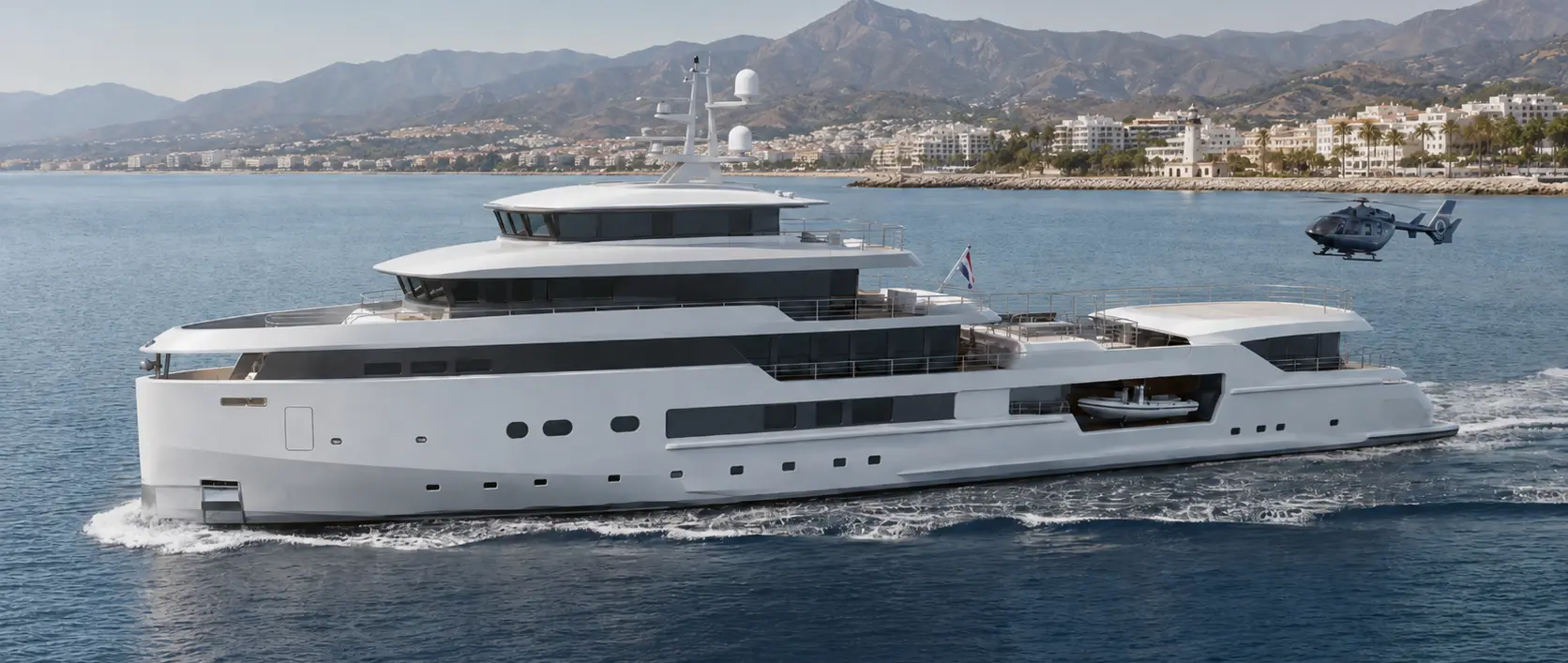
For a growing group of owners, the next yacht is no longer defined primarily by length, speed or marina presence, but by where it can go, how long it can remain there and what it can do on arrival.
For much of the modern superyacht era, ownership revolved around a familiar geography. Yachts moved between established Mediterranean ports in summer and the Caribbean in winter, with the principal design questions centred on guest accommodation, exterior entertaining spaces, speed, style and access to the most desirable marinas. That model remains important, but it no longer describes the ambitions of every experienced owner. A growing number are looking beyond the established circuit and asking for yachts capable of crossing oceans comfortably, remaining away from shore support for longer periods and carrying the equipment needed for a broader programme.
The movement towards explorer yachts should not be exaggerated into a complete transformation of the market. Conventional displacement, semi-displacement and fast motor yachts continue to attract substantial demand, and many owners have no desire to cruise remote coastlines or undertake long passages. The evidence from recent orders and repeat clients nevertheless shows that explorer capability has become more commercially and culturally important. Damen Yachting’s July 2026 sale of another Xplorer 60 was explicitly linked to an owner seeking to travel farther, remain away for longer and combine private adventure with scientific research. Bering sold the first two hulls of its 50-metre Bering 165 during the opening months of 2026, while Cantiere delle Marche announced successive 45-metre explorer orders, including one placed by a repeat owner moving up from an earlier yacht.
These projects are not identical, and neither are the owners behind them. Some want polar capability, others are interested in islands, diving, wildlife or long periods in warm-water anchorages. Some expect to support research or conservation, while others simply want a yacht that is less dependent on the established marina network. What connects them is a change in emphasis: the yacht is being selected as an operational platform for a desired life, rather than as a luxury object to which an itinerary is added afterwards.
The attraction of an explorer yacht often becomes clearer after an owner has already lived with a conventional yacht. First-time buyers may understandably focus on dimensions, finishes, cabins and visible amenities because these are the easiest qualities to compare during a show or shipyard visit. Experience changes the conversation. After several seasons, owners understand which areas they use, which equipment constrains the itinerary, how often the yacht requires shore support and whether the vessel genuinely allows the spontaneity they expected.
An experienced owner may discover that the important limitation is not the size of the saloon but the amount of fuel, refrigerated storage, spare parts or tender capacity on board. A yacht may be exceptionally comfortable in the Mediterranean yet become operationally dependent when cruising far from major ports. Water production, waste capacity, cold storage, machinery redundancy, crew accommodation and technical access all become more significant when the next suitable repair facility is not a short run down the coast.
This helps explain why repeat owners appear frequently in explorer-yacht announcements. Cantiere delle Marche’s February 2026 sale of a 45-metre explorer involved an owner who had previously owned a Nauta Air 110 from the same yard. The shipyard described the move not merely as an increase in length, but as progression towards greater engineering capability, seaworthiness and onboard wellbeing. A second 45-metre contract announced days later reinforced the appeal of the same underlying concept while allowing substantial owner-specific changes.
The distinction matters because explorer ownership is not necessarily another form of two-foot-itis. The new yacht may indeed be larger, but the objective is usually more functional than simply acquiring additional length. The owner wants a platform capable of supporting a different programme: longer voyages, more varied climates, heavier tenders, specialist equipment or a less predictable itinerary.
Long range is one of the most visible explorer-yacht specifications, but fuel capacity alone does not create genuine autonomy. A yacht designed for extended operation must support the people and machinery on board throughout the voyage. Fresh water must be produced reliably, provisions stored, waste managed and equipment maintained without assuming that a technician or spare component can arrive the following morning.
This changes the way space is allocated. A conventional yacht may devote a high proportion of its volume to guest areas because support is never far away. An explorer requires larger technical stores, workshops, refrigeration, freezers, laundry capacity, waste systems and crew spaces suited to longer periods of continuous operation. Machinery must be accessible enough to maintain at sea, and critical services may require greater redundancy because one failure should not end the itinerary.
Sanlorenzo describes its 500Exp as a purpose-made platform combining reinforced construction and engineering intended to support long-range cruising across varied conditions. Bering’s smaller steel explorers apply the same principle at a different scale: the 23.85-metre Bering 78 is published with a range exceeding 3,000 nautical miles at eight knots, while the Bering 88 is stated to exceed 5,000 nautical miles at an economical cruising speed.
These figures demonstrate another characteristic of explorer ownership: speed is often exchanged for endurance. A full-displacement steel yacht travelling at eight, nine or ten knots may appear slow beside a fast Mediterranean cruiser, but the owner is buying efficient passage-making, seakeeping and the ability to arrive with substantial reserves. The value is not measured by how quickly the yacht moves between Cannes and Saint-Tropez, but by how confidently it can undertake a long crossing or remain outside the normal support network.
Autonomy should not be confused with complete independence. Explorer yachts still require fuel, provisions, permissions, specialist servicing and carefully planned logistics. Remote cruising may increase rather than reduce the need for professional management because mistakes become harder to correct. The advantage is that the yacht gives the captain and owner a wider operating envelope within which those resources can be planned.
Explorer yachts were once associated strongly with polar cruising, converted commercial vessels and a relatively austere form of adventure. The category is now much broader. Owners use explorer-capable yachts in Indonesia, the South Pacific, Alaska, Patagonia, the Indian Ocean and less-developed parts of the Mediterranean and Caribbean, as well as in high-latitude regions.
The appeal is partly the destination, but it is also the experience of reaching it privately. Established yachting centres offer excellent marinas, restaurants and services, but they also bring crowded anchorages, highly visible ownership and itineraries that can begin to feel repetitive. An explorer yacht allows the owner to substitute a marina berth for a remote bay, a familiar beach club for a dive site or a tightly scheduled social season for a longer voyage shaped by weather, wildlife and local conditions.
Damen Yachting’s latest Xplorer 60 sale was described around exactly this ambition. The owner’s programme is expected to combine private exploration with opportunities to support scientific research in remote regions. The yard said the order reflected increasing interest from owners seeking yachts capable of travelling farther and supporting more varied uses. The first Xplorer 60, delivered as After You in 2025, later returned to Vlissingen for optimisation ahead of ambitious global cruising plans with its accompanying Yacht Support vessel.
The movement is therefore not simply towards harsher climates. It is towards fewer geographical assumptions. An explorer yacht can still spend a summer in the Mediterranean, but it is not designed around that use alone. Damen has described its Xplorer 60 as equally capable of appearing in established yachting destinations and operating in polar regions, illustrating how the modern explorer is intended to retain luxury and visual presence without sacrificing the machinery, storage and hull characteristics needed for more demanding voyages.
The explorer yacht is increasingly defined not only by destination but by activity. Owners want diving equipment, large tenders, submarines, helicopters, personal watercraft, fishing boats, scientific instruments and land vehicles. Carrying these effectively requires more than finding unused deck space. The yacht needs cranes, fuel arrangements, charging capacity, workshops, storage, maintenance access and safe launch-and-recovery procedures.
Large tenders are particularly important. In remote areas, the tender may be the principal connection between the yacht and the shore, and it may need to operate in poor weather, carry substantial equipment or cover significant distances. A conventional tender garage designed mainly for short guest transfers may be inadequate. Explorer platforms therefore tend to prioritise larger boat decks, protected storage and cranes capable of handling heavier craft.
Concepts such as Heesen’s Xventure illustrate the extent of this thinking. The design included provision for a helicopter, an 11.4-metre sports-fishing tender, a second landing craft, diving equipment and optional submarine operations. The underlying objective was not merely to accumulate toys, but to give guests several ways to reach and use remote environments.
This capacity can also separate different parts of the owner’s life. A support vessel may carry helicopters, laboratories, boats, fuel and specialist personnel, leaving the principal yacht quieter and less operationally congested. Damen’s conversion of Gene Chaser created wet and dry laboratories, accommodation for scientists and a large multipurpose deck supporting research equipment and landing craft. The arrangement allowed research operations to remain separate from family life aboard the main yacht.
The result is a change in what ownership can mean. The yacht may remain a place of leisure, but it can also become a diving base, research platform, mobile workshop, helicopter base or logistical centre. Owners are not necessarily rejecting luxury; they are asking luxury to support a purpose beyond remaining comfortable at anchor.
The growing appeal of the category also reflects a change in design. Earlier expedition yachts often displayed their commercial origins openly, with workboat proportions, utilitarian interiors and machinery-led layouts. Modern explorer yachts can retain robust construction and long-range capability while offering interiors comparable with contemporary custom superyachts.
Sanlorenzo positions the 500Exp around both remote capability and refined onboard living. Cantiere delle Marche’s recent orders combine steel-hulled engineering with interiors shaped around light, calmness and generous volume. The shipyard’s ability to adapt a proven explorer concept to individual owners demonstrates how capability and customisation can coexist within the same platform.
This combination removes one of the historic compromises associated with expedition ownership. The owner no longer has to choose as starkly between a glamorous yacht and a capable one. Large windows, spas, pools, beach clubs and refined interiors can coexist with steel hulls, long range, substantial storage and technical redundancy, although every design choice still carries consequences for weight, volume and complexity.
The appearance of explorer yachts has also softened. Some retain pronounced bows, high freeboard and exposed working decks, while others use more conventional superyacht lines. The term explorer now covers a wide spectrum, from true expedition platforms to luxury displacement yachts with enhanced range and storage. This broadening has helped the category attract owners who like the freedom associated with exploration but do not want a vessel that resembles a commercial conversion.
A yacht capable of spending several weeks away from established ports is useful only if the owner can remain aboard for that period. Improvements in communications have made this more realistic. Reliable satellite connectivity allows owners to work, communicate with family, manage companies and access entertainment from locations that would previously have felt professionally isolating.
This does not eliminate the difficulty of remote communications, and responsible yachts retain multiple systems rather than relying entirely on one network. It nevertheless changes the relationship between ownership and time. An owner who can conduct meetings and remain connected no longer needs to compress yacht use into short holidays or remain within easy reach of an airport.
Privacy is another part of the appeal. Remote cruising reduces exposure to busy marinas, photographers and the social concentration of established yachting destinations. The yacht becomes a more effective private environment because it can choose distance rather than merely constructing privacy screens around a berth.
Longer stays also reward the qualities explorer yachts tend to provide: quieter displacement operation, larger stores, comfortable crew areas and multiple interior and exterior spaces suited to changing weather. The owner is not simply visiting the yacht for a weekend. The vessel becomes a temporary home, office and base for a wider programme.
Explorer yachts once appeared more specialised and potentially harder to resell than conventional motor yachts. The expansion of the category has begun to reduce that concern. A larger pool of buyers now understands the value of steel construction, range, volume and established explorer credentials, particularly when a yacht comes from a yard with an identifiable fleet and after-sales network.
Cantiere delle Marche’s official pre-owned announcements provide evidence of activity within a recognised explorer fleet. In March 2026, the yard described the sale of the Acciaio 130 Presence as its fourth pre-owned transaction in six months, following the sales of Aurelia, Storm and Narvalo. In April, CdM announced the off-market sale of the 499GT RJ, reporting that the RJ line had reached five units sold.
These figures come from the shipyard rather than an independent market index, but they indicate that recognised explorer yachts can attract secondary-market demand. For an owner considering a specialised vessel, the decision becomes easier when the yacht is not perceived as an eccentric one-off that will be difficult to place with another buyer.
Recognisable ranges from Damen, Sanlorenzo, Bering and Cantiere delle Marche create a clearer market category, while proven sister yachts provide evidence of construction, performance and operating experience. Resale value will still depend on condition, age, specification, refit requirements and whether the yacht’s capabilities are genuine, but the wider market understands the category better than it did a decade ago.
Explorer yachts are not automatically the rational choice for every owner. Steel construction, large fuel capacity, extensive machinery, specialist tenders and greater redundancy all carry costs. The yacht may be slower, heavier and more expensive to berth, maintain and crew. Equipment intended for rare expeditions can occupy volume and require servicing even when the yacht spends most of its time in familiar waters.
A design can also become trapped between appearance and reality. Some yachts are marketed with explorer styling but lack the range, stores, redundancy, hull strength or technical arrangement required for demanding remote operation. Buyers should examine the actual cruising programme and assess whether the specification supports it, rather than relying on a high bow, dark hull and large tender crane as proof of capability.
Polar operation introduces further questions involving hull strengthening, heating, insulation, survival equipment, ice navigation and regulatory compliance. Tropical remoteness creates different pressures, including air-conditioning demand, refrigeration, water production and corrosion. A yacht designed for one kind of exploration may not be equally suited to another.
There is also an environmental contradiction. Efficient displacement hulls can reduce fuel consumption per mile compared with faster yachts, and scientific or conservation work can produce genuine value, but remote cruising still consumes fuel and brings private vessels into sensitive environments. Purposeful ownership should not be presented as automatically sustainable. The yacht’s impact depends on how it is designed, managed and used.
The movement towards explorer yachts reflects a wider maturation of superyacht ownership. Owners who have already experienced the established circuit are becoming more precise about what they want from the vessel. Greater length may be part of the answer, but range, autonomy, equipment capacity and operational flexibility are increasingly more important than size alone.
Recent sales provide tangible evidence. Damen’s Xplorer fleet continues to expand, Bering secured two contracts for its new 50-metre flagship within months, and Cantiere delle Marche has combined new orders with active pre-owned transactions. These announcements do not prove that the whole market is becoming explorer-led, but they show that the category is no longer peripheral.
The strongest explorer yachts succeed because they do not treat capability as a decorative theme. Their hulls, machinery, storage, crew arrangements and tenders are designed around the intended programme. Luxury remains central, but it is supported by the less visible qualities that allow the yacht to keep moving when the marinas, technicians and provisioning networks have been left behind.
For these owners, the yacht is no longer simply the destination. It is the means of reaching destinations that would otherwise remain inaccessible—and of remaining there long enough to make the journey worthwhile.
Continue reading
Ferretti Group has introduced its Quality Promise programme, adding one year of limited coverage beyond the standard warranty for eligible yachts up to 45m.
Where Is the Best Place to Buy a Superyacht? There is no single best country or boat show for every buyer: the strongest market …
What Paperwork Do You Need When Buying a Superyacht? A superyacht acquisition requires far more than a bill of sale: buyers normally need a …
What Is a Superyacht Sea Trial? A superyacht sea trial is the buyer’s opportunity to observe the yacht operating underway before contractual acceptance, testing …
Superyacht Guide
Continue into the wider Superyacht Guide.