
Williams ES10M Secures First 80m-Plus Yacht Customer for Threefold Energy Upgrade
Williams Grand Prix Technologies has disclosed that the first customer for its ES10M marine battery system is an 80-metre-plus yacht targeting triple the installed …

© Respective copyright holder / International Yacht Brokers Association; published with the original announcement or interview, individual photographer not identified.
The International Yacht Brokers Association examines how AI could help brokers interpret changing client preferences while maintaining privacy and professional judgement.
The International Yacht Brokers Association has addressed artificial intelligence in its 1 November industry article on more individualised client service. The association's discussion considers how technology can help brokerage teams recognise changes in customer preferences and identify relevant opportunities, while retaining human judgement and maintaining confidentiality. It is an examination of emerging working practices, rather than an announcement that IYBA has launched a proprietary AI platform or that its members are required to adopt one.
For the superyacht market, the discussion raises questions extending well beyond automatic recommendations. Brokerage and charter management involve complex asset information, personal relationships, commercial confidentiality and professional responsibilities. The usefulness of a particular AI application therefore depends on the quality of its information, the limits placed on its operation and the way staff use its output.
The association draws attention to information that brokerage teams already collect during ordinary client relationships. This may include previous enquiries, preferred yacht characteristics and information provided in discussions about charter destinations. A conventional customer relationship management system can make that information available to the staff responsible for a particular client.
An analytical system may additionally help identify changes across a series of enquiries. For example, a prospective buyer who has previously asked about Mediterranean charter yachts may begin seeking information on long-range vessels. That could justify a conversation about evolving cruising objectives, but it does not establish a decision to purchase. The distinction between an observable change and an inferred intention should be reflected in the way a brokerage records and uses information.
Superyachts are not interchangeable products. Two vessels of similar length and price may offer substantially different machinery arrangements, accommodation layouts, maintenance histories and cruising capabilities. An automated comparison that relies predominantly on dimensions or asking prices can miss differences that determine whether a yacht actually meets the client's requirements.
A useful technical application might help staff retrieve and organise information from verified particulars. The broker can then assess the significance of that information in the context of the enquiry. The final recommendation should distinguish confirmed characteristics from incomplete or outdated records. A confident automated description cannot establish a technical fact that the seller or appointed representative has not verified.
The IYBA article discusses the potential for identifying shifts in client interests before a formal request arrives. There can be commercial value in noticing that a client has started exploring an unfamiliar cruising region or a different category of yacht. However, a pattern in previous enquiries is inherently ambiguous.
A search for hybrid propulsion could reflect a possible purchase, curiosity about the technology or research undertaken on behalf of someone else. It would be inappropriate to translate that activity directly into a definitive client profile. A brokerage that uses AI-assisted analysis should make it possible for staff to review the underlying evidence and correct inaccurate assumptions.
Charter brokers routinely consider guest numbers, cabin arrangements, desired activities and available dates alongside the client's budget. Those requirements may change during discussions as the party becomes clearer about what it wants from the journey. Organising the information can help the broker keep track of the alternatives under consideration.
The challenge is that availability and rates can change independently of the information recorded in a client file. A tool suggesting a vessel cannot confirm that the yacht is still available on the requested dates or that a published price remains valid. The relevant charter representatives must confirm those details. An analytical system should therefore assist the enquiry rather than be treated as a booking authority.
The effectiveness of any analytical application depends on the reliability of the information it receives. A brokerage database may contain historical specifications, imported marketing descriptions, contact notes and documents obtained at different stages of a transaction. Unless these are distinguished clearly, a system may present older information as if it were current.
A practical implementation needs to preserve the origin and date of important yacht particulars. Staff should know whether a statement came from a current central-agent listing, an earlier brochure or an unverified third-party record. The same principle applies to client preferences: a requirement explicitly confirmed by a client deserves different treatment from an inference produced by software.
The association emphasises that trust remains central to the brokerage relationship. Clients may provide information about travel arrangements, ownership structures and personal requirements that should not be circulated beyond the people who need it. Deploying an AI application does not create a new entitlement to use that information.
Before introducing a service, a brokerage should establish what records the application will receive, where information is processed, how access is controlled and whether data is retained by an external provider. Staff need to understand these conditions as part of their normal working procedures. A useful application is not necessarily the one that receives the greatest amount of data; it is one whose access is proportionate to the work it has been introduced to support.
The yacht broker's work involves evaluating commercial proposals, understanding the client's instructions and communicating with other professionals. Software can assist with administrative and analytical tasks, but it cannot assume responsibility for professional judgements merely because it generates a plausible recommendation. That is particularly relevant where a proposed transaction depends on the interpretation of complex contractual terms.
A responsible workflow gives staff an opportunity to check important outputs before sharing them externally. It also distinguishes preparation of a draft from approval of a proposal or commitment. Those boundaries matter because an apparently routine message can contain statements about availability, price or terms that the brokerage is not yet authorised to confirm.
The introduction of AI tools should be assessed against specific working objectives rather than general expectations about automation. A brokerage might seek to reduce the time required to retrieve vessel information, identify missing details in an enquiry or maintain consistency between approved marketing records. These are distinct objectives and require different measures of performance.
Useful evaluation criteria include factual accuracy, the frequency of staff corrections, the time saved on verified tasks and the quality of the resulting client communication. It is also important to examine errors that may be costly despite occurring infrequently. A system that accelerates ordinary administration but produces occasional misleading commercial statements may require additional safeguards before broader deployment.
The association's discussion has implications for staff development as well as technology procurement. Employees using analytical or generative systems need to understand both the intended function and the limits of the application. They should be able to recognise when an output contains unsupported information or an inference that needs further confirmation.
Training can include the distinction between publicly available vessel particulars and confidential client records, the handling of commercially sensitive documents and the procedures for reviewing generated text. Managers should also provide a clear route for staff to report incorrect results. That feedback can help establish whether the system is genuinely supporting the brokerage rather than creating another source of information that employees must continually reconcile.
IYBA's November article illustrates the growing attention being paid to AI within the brokerage profession. Its central relevance to the superyacht market is the possibility of using information more effectively while preserving the discretion and expertise clients expect from their representatives. That balance cannot be established by technology alone.
The practical question for brokerage firms is how to integrate suitable tools into a controlled workflow, with verified information and accountable human decisions. The association has not presented independent measurements of the commercial performance of a particular AI product in this article. Its contribution is instead to identify a developing area of professional practice, where the quality of implementation will determine whether clients experience a genuine improvement in service.
Original primary record: International Yacht Brokers Association. © Respective copyright holder / International Yacht Brokers Association; published with the original announcement or interview, individual photographer not identified. Original first-party media: source photograph or official illustration. Copyright and image source are credited; first-party availability does not imply unrestricted reproduction permission.
Continue reading
Williams Grand Prix Technologies has disclosed that the first customer for its ES10M marine battery system is an 80-metre-plus yacht targeting triple the installed …

A November 2026 official America's Cup technical report explains how sensors monitor speed, ride height, structural strain and control inputs aboard the foiling AC75.

Beneteau chief Bruno Thivoyon says electric propulsion technology could eventually add only 1–3% to boat prices as the group works with Fountaine Pajot on …
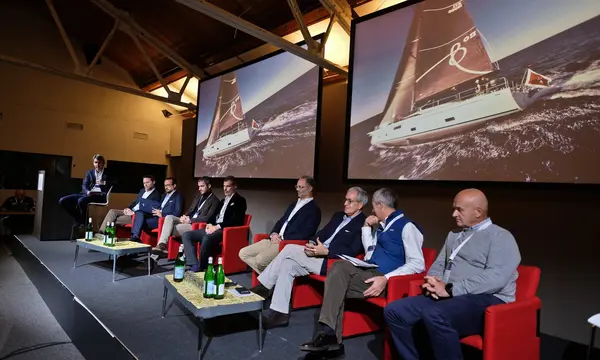
Owners and builders at Genoa's 27 November Sailing Super Yacht Forum shared lessons on hybrid propulsion, noise, onboard controls and environmental life-cycle assessment.
Superyacht Guide
Continue into the wider Superyacht Guide.
Business opportunities · Superyacht Guide
Companies serving the superyacht market can discuss clearly identified advertising, sponsorship and business-profile opportunities. Commercial activity remains separate from independent editorial coverage.